Updated
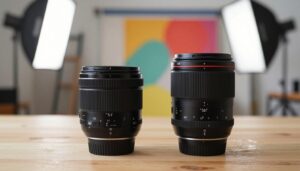
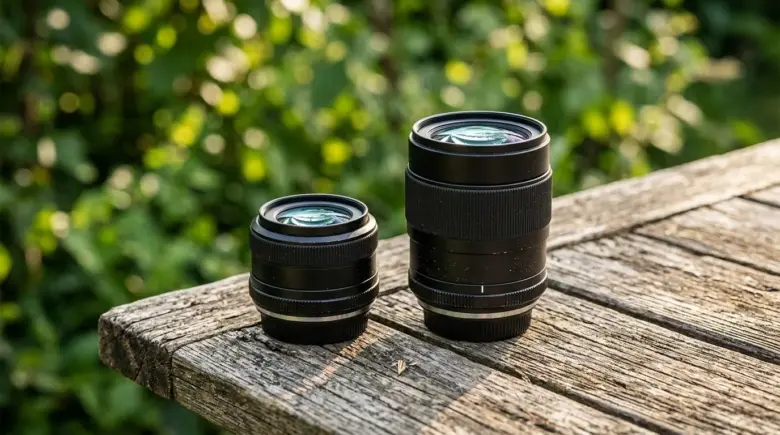
In the 85mm vs 50mm choice, the short answer depends on your room. An 85mm is the better pure portrait lens: it gives stronger background blur and flattering faces from a comfortable distance. A 50mm is the better all-rounder: it fits small spaces, works for half-body shots and costs less. If you shoot outdoors or in a studio, lean toward 85mm. If you shoot at home, lean toward 50mm.
The rest of this guide shows what changes in practice, from how far you stand to how much of the background survives in the frame.
The main differences
| Factor | 50mm | 85mm |
|---|---|---|
| Horizontal view on full frame | About 40 degrees | About 24 degrees |
| Head-and-shoulders distance | About 1 m | About 1.8 m |
| Full-body distance | About 4 m | About 6.5 m |
| Physical opening at f/1.8 | About 28 mm | About 47 mm |
| Background in frame | More of it | A narrow slice |
| Usual size and cost | Smaller, cheaper | Larger, costs more |
On a 1.5x APS-C camera, a 50mm already behaves much like a 75mm. In that case, a 50mm gives you the 85mm look, and a 33mm or 35mm is the true “normal” lens.
Portraits: why 85mm has the reputation
Distance controls how a face looks. At a head-and-shoulders crop with a 50mm, you stand about 1 meter from the person, close enough for the nose to appear a little larger. With an 85mm, you stand near 1.8 meters and proportions look calmer. That is the main reason it became the standard lens for headshots.
The extra distance also changes the mood of a session. Some people relax with you further back, while others find it easier to talk at 50mm range. If you work with children or with people who are shy of the camera, try both before you decide. Our full portrait prime lens guide compares more focal lengths.
Background blur
With the same framing and the same f-number, an 85mm gives more blur than a 50mm. Its opening is larger, and its narrow view keeps less background in the frame, so it is easier to hide a messy street by moving a step to one side. A cheap 85mm f/1.8 can look softer in the background than an expensive 50mm f/1.2. Our guide on how to get bokeh shows how distance adds to this effect.
Small rooms and groups
Here the 50mm wins clearly. A typical living room gives you about 3 to 4 meters from wall to wall. An 85mm cannot show a full-length person in that space, and a family of four is a challenge. A 50mm can manage a half-body shot of two people with room to spare.
- Under 3 meters of working room: choose 50mm or wider.
- 3 to 5 meters: a 50mm is easy, and an 85mm works for one person.
- Over 5 meters, or outdoors: an 85mm works for almost anything.
Beyond portraits
What a 50mm does better
Everyday family photos, food on a table, street scenes, documentary work and video interviews. A 50mm lens is often the only lens you need for a day out.
What an 85mm does better
Stage shows from the front rows, details at weddings, compressed landscapes and sports from the side of a small field. It also picks one person out of a crowd, where a 50mm would show the whole scene.
Low light and handling
Most versions of both lenses come in f/1.8 and f/1.4, so they gather the same light per area of the sensor. The difference lies in shake. A longer lens magnifies small movements, so you need a faster shutter speed when shooting by hand. A rough guide is one over the focal length, which means about 1/50s for a 50mm and 1/85s for an 85mm. Stabilization helps with camera shake, but not with a moving subject. For more on stops and shutter speeds, see what makes a fast lens useful.
How the two lenses render a person
Standing further back changes more than a nose. With an 85mm, the background takes up a narrow part of the scene, so a single tree or wall can fill everything behind a person. That makes it easy to keep colors simple. With a 50mm, more of the surroundings appear, so the place becomes part of the picture. The normal lens idea explains why a 50mm looks so neutral: it roughly matches the perspective of a print viewed at a usual distance.
Neither is more honest than the other. An 85mm portrait feels intimate and polished, and a 50mm portrait feels closer to a real conversation. Think about which of these suits your subject before you choose, and try the two side by side if a friend or a local store can lend you one.
How to choose in three steps
- Measure your usual space. Note the longest distance you can stand from your subject.
- Test with a zoom. Tape a kit or telephoto zoom at 50mm for one session, and at 85mm for another. Most kit zooms reach one of these.
- Count who is in the frame. One person most of the time points to 85mm. Two or more points to 50mm.
Should you buy both?
Many portrait photographers do, since the two lenses cover different framings at each session. Start with the one that fits your space, then add the other later. The 50mm is the cheaper way in, and a used copy makes it cheaper still, as shown in our guide to used camera lenses. If you already own a 50mm and shoot mainly people, an 85mm f/1.8 is one of the most useful upgrades you can make. If you are still choosing a wider first lens, read 35mm vs 50mm before you buy.

Adriano Antonio Rodrigues da Silva edits PrimeFrame Studio. The guides on this site are research-based explainers on prime lenses, built from manufacturer specifications and published technical tests. They are not personal lab reviews.