Updated
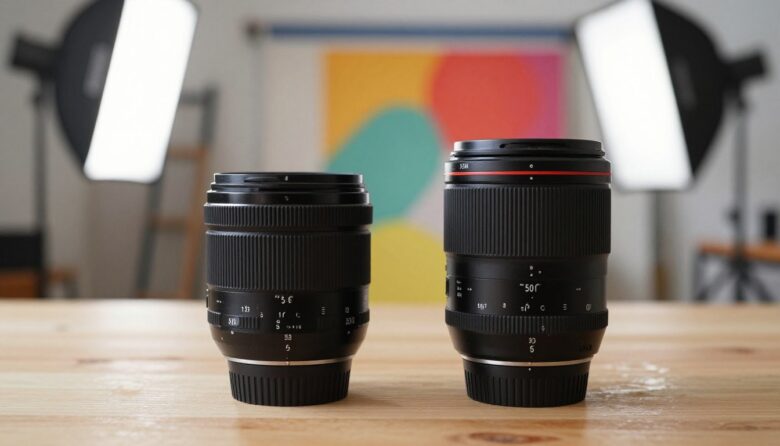
The short answer to 35mm vs 50mm: pick 35mm if you want the place to matter as much as the person, and 50mm if you want the person to matter more than the place. On a full-frame camera, a 35mm lens sees about 54 degrees across the frame. A 50mm sees about 40 degrees. That gap of 14 degrees changes how close you stand, how much background you keep and how you work a room.
Neither lens is better. The right one depends on what you shoot most, how much space you have and how much background you want to remove. The table below gives the differences at a glance, and the rest of this guide explains when each one matters.
35mm and 50mm side by side
| Factor | 35mm | 50mm |
|---|---|---|
| Horizontal view on full frame | About 54 degrees | About 40 degrees |
| Look of the scene | Open, includes surroundings | Neutral, tighter framing |
| Background | More of it stays in frame | Less clutter to manage |
| Blur at the same aperture and distance | Weaker | Stronger |
| Faces up close | Can stretch if you get too near | More forgiving |
| Small rooms | Easy | You may run out of space |
| Equivalent on a 1.5x APS-C camera | About 52mm | About 75mm |
How the two lenses change a photo
Focal length decides how much of the scene reaches the sensor, as the Cambridge in Colour lens tutorial explains. It does not change perspective by itself. Perspective comes from where you stand. The lens only sets how close you must stand to fill the frame the way you want.
That is why the two lenses feel so different in use. To frame a person from the waist up, you stand closer with the 35mm. Being closer pushes the background further away in relative terms, so it looks wider and more present. Step back with a 50mm for the same framing, and the background looks closer and takes up less of the picture.
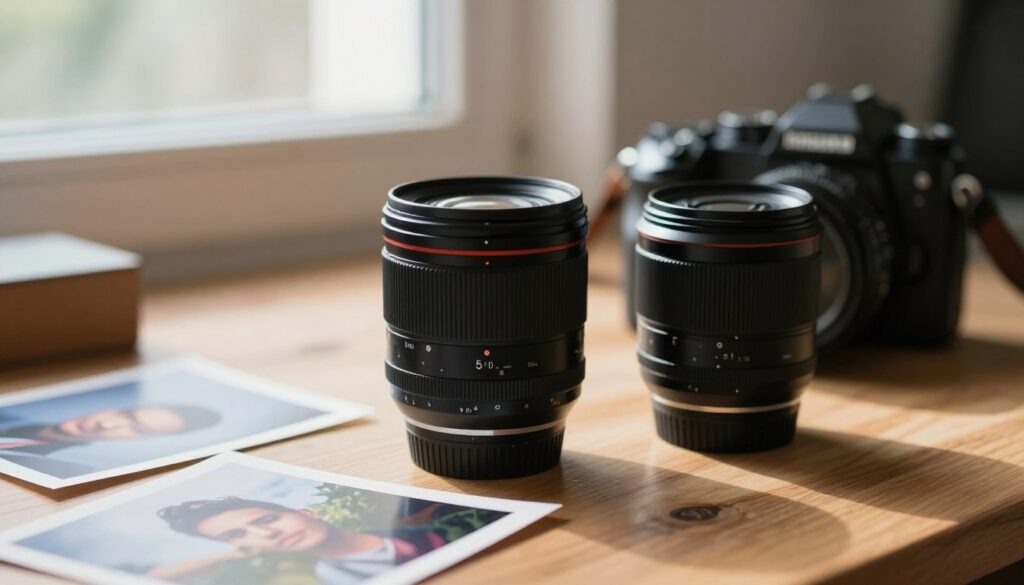
Choose 35mm if you shoot these
- Street and travel: you can include a sign, a doorway or a crowd with the subject in one frame.
- Family life at home: indoor rooms are rarely big enough for a 50mm to show two or three people together.
- Weddings and events in tight venues: it records the setting along with the moment.
- Environmental portraits: the workshop, kitchen or studio becomes part of the story.
- Video: a wider view hides small movements and suits handheld shots.
Choose 50mm if you shoot these
- Portraits on a budget: it gives you natural-looking faces from a comfortable distance.
- Details: food, hands and objects fill the frame without being distorted.
- Busy backgrounds: its narrower view lets you frame out cables, cars and passers-by.
- Low-cost entry to fast apertures: most systems offer an affordable f/1.8. Read the full case in our guide to what a 50mm lens is good for.
Background blur: the honest comparison
At the same aperture and the same distance to the subject, a 50mm blurs the background more than a 35mm. If you keep the same framing instead, the difference shrinks but stays in favor of the 50mm. A simple way to estimate the blur is to divide focal length by f-number. A 50mm at f/1.8 gives an opening of about 28mm, while a 35mm at f/1.8 gives about 19mm. Our step-by-step guide on how to get bokeh shows the other levers you can pull, including distance to the background.
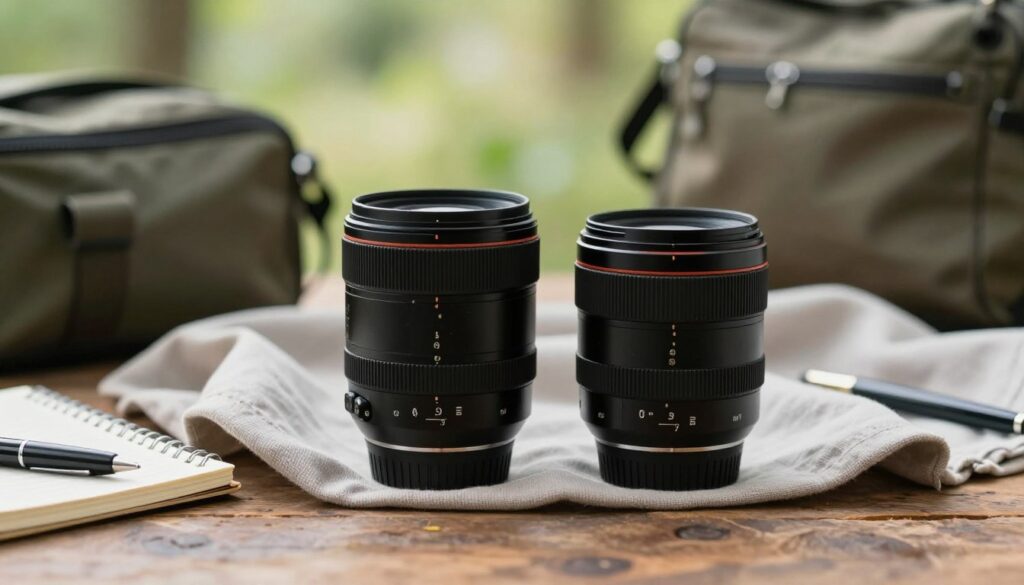
Low light is mostly a tie
Both lenses are commonly sold at f/1.8 and f/1.4, so they gather the same amount of light per area of sensor. The 35mm has one small advantage: slower shutter speeds are easier to hold steady with a wider lens. For a full explanation of aperture and exposure, see what makes a fast lens useful after dark.
Size, weight and cost
Within the same brand and aperture, 35mm and 50mm lenses tend to be close in size, but the 50mm is usually a little cheaper. The reason is that 50mm designs are simple and have been refined for decades, while a fast 35mm for a mirrorless or SLR body needs a more complex design. That gap is why a 50mm f/1.8 is often a brand’s least expensive fast lens. If budget decides this for you, a used 35mm can close the difference, as our guide to used camera lenses shows.
A test you can do today, for free
- If you own a kit zoom, tape the zoom ring at 35mm for one day of normal shooting.
- Do the same at 50mm the next day, in similar places.
- Count the frames where you wanted to step back and could not, and the frames where you wanted to get closer.
- On a crop camera, use about 23mm and 33mm to get the same views.
If your existing photos are on a computer, sort them by focal length in your photo software. The cluster you already favor is usually the answer. If you find the same frames at both ends, consider whether a fixed lens or a zoom serves you better.
Common questions
Is 35mm or 50mm closer to what the eye sees?
There is no exact match, because human vision has no fixed edge. The 50mm is usually called “normal” because objects look about the right size through it, while 35mm comes closer to the area you actually pay attention to.
Which is better for a first prime?
On full frame, choose 50mm for portraits and 35mm for everyday scenes. On APS-C, a 35mm behaves like a 50mm and is usually the better first buy.
Can I own just one?
Yes. Many photographers work with one of them for years. If you are still undecided, start with the one that suits the space you shoot in most often.
Next step
Once you pick a focal length, learn to work with it. Our guide to the benefits of a prime lens includes practice drills that make a single lens far more useful.

Adriano Antonio Rodrigues da Silva edits PrimeFrame Studio. The guides on this site are research-based explainers on prime lenses, built from manufacturer specifications and published technical tests. They are not personal lab reviews.