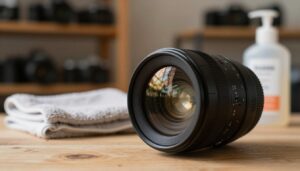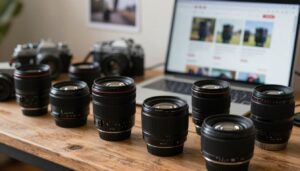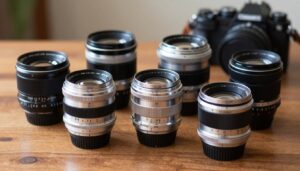
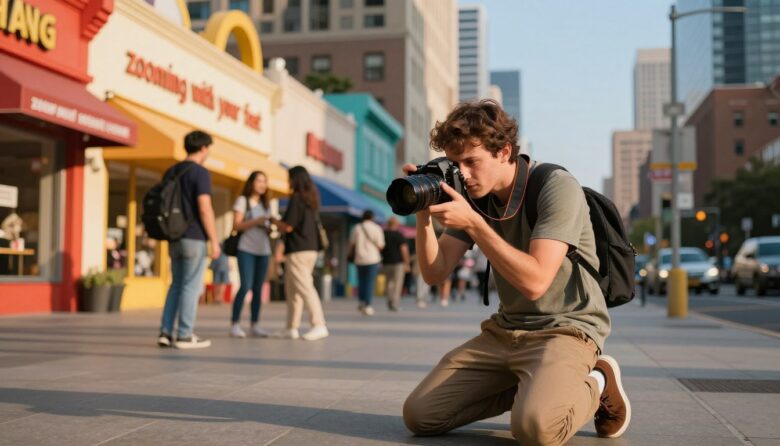
I often carry a single prime lens and let movement shape my images. This forces me to plan composition and to trust how focal length affects framing.
Many photographers think prime lenses limit creativity, but I find that walking, stepping closer, or stepping back can replace a zoom lens. That physical change in length brings a fresh intimacy to scenes.
What I learned after forcing myself to shoot with one lens
I remember the first time I left my zoom lens at home and committed to a single prime—it felt limiting at first, almost uncomfortable. But after a few hours, something changed. I stopped thinking about gear and started paying closer attention to distance, light, and how elements aligned in the frame. Instead of reacting, I became more intentional with every shot. It wasn’t about getting more photos, but about getting better ones.
In my experience, this approach doesn’t magically improve your photography overnight, but it does train your eye in a very real way. You begin to notice small details—like how a slight step to the side cleans up a background, or how moving closer changes the emotional impact of a subject. That awareness carries over even when you go back to using zoom lenses.
I’ve found that when I rely less on equipment and more on positioning, my photos feel more deliberate and less accidental.
If I had to give one practical tip, it would be this: pick one focal length and stick with it for an entire session, without exceptions. Don’t switch lenses when it gets hard—that’s exactly when you’re learning the most. Over time, this habit builds confidence and helps you understand composition in a way that no setting or feature can replace.
When I use a fixed lens, I learn the limits and strengths of one focal length. That practice makes me a better photographer and improves my overall camera skills.
Key Takeaways
- Using prime lenses trains movement and composition.
- Changing position alters perspective without mechanical zoom.
- Mastering focal length creates closer subject connection.
- Carrying one lens simplifies decisions and boosts creativity.
- Physical framing is a core skill for any photographer.
Understanding the Concept of Zoom With Your Feet
Changing my position often does more for a frame than changing focal length. On crop-sensor cameras like the Canon Rebel or Nikon D3300, the kit lens (usually 18–55mm) sets a fixed view that teaches you to move.
I recommend leaving zoom lenses in the bag and using prime lenses for a day. That exercise forces me to recompose and study how focal length and lens choice affect perspective.
Important note: many photographers argue that “zooming feet” is a misnomer. You are not changing the optical focal length; you are changing the relationship between camera and subject.
“If you want to get closer to a subject, you must physically move.”
- Kit lenses show how length dictates view on common cameras.
- Prime lenses keep you focused on composition and light.
- Practicing fixed length builds skill in reading scenes.
| Camera | Typical Kit Lens | Practice Tip | Benefit |
|---|---|---|---|
| Canon Rebel | 18–55mm | Use a 35mm prime for a day | Better framing instincts |
| Nikon D3300 | 18–55mm | Step closer instead of zooming | Stronger subject connection |
| General tip | Any kit lens | Set aside zoom lens | Learn light at one length |
| Photographers | Prime lenses | Commit to a focal length | Sharper composition skills |
The Mechanics of Focal Length and Composition
When I swap focal lengths, the scene rearranges itself in ways stepping cannot reproduce. That difference matters when I want to control how a subject sits inside a frame.
The Difference Between Recomposing and Zooming
Recomposing means moving to change the angle and placement of a subject. It alters perspective and the relation between foreground and background.
Optical change shifts the angle of view and compresses or expands the background. For example, a 70–200mm lens on a Nikon D750 gives about a 34° view at 70mm and narrows to roughly 12° at 200mm. That change can make backgrounds blurrier and more compressed.
How Angle of View Affects Your Subject
A wider angle admits more of the scene and can clutter the frame if you are not careful. Every point inside the frame counts, so I move to isolate the subject when needed.
“Changing focal length had a massive effect on the background; movement changed the relationship to it.”
- I used a 70–200mm and watched the background compress as length increased.
- Recomposing alters composition; optical length alters perspective and depth.
- Move to isolate a subject, or change focal length to change background effect.
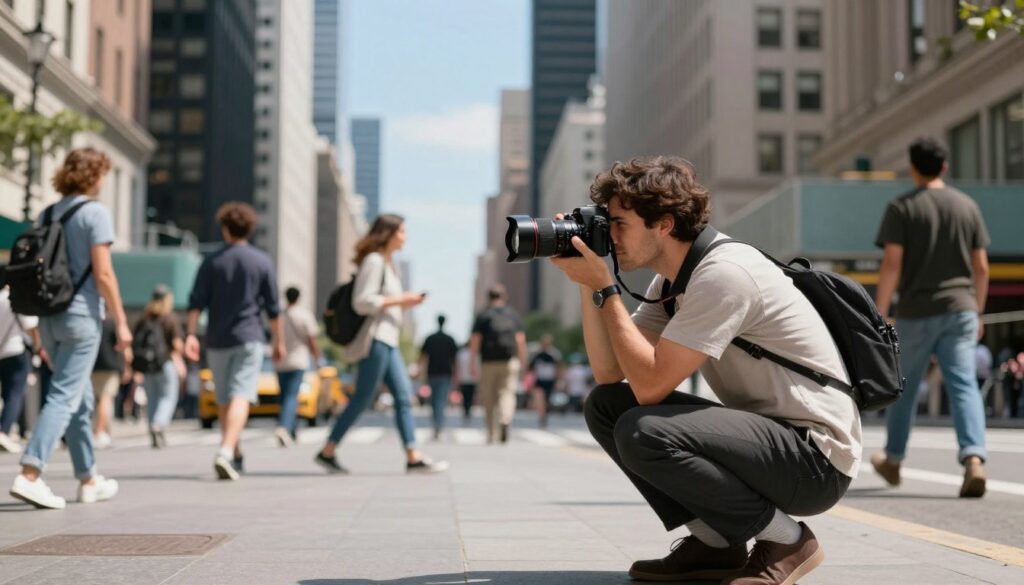
| Action | Effect on Background | When to Use |
|---|---|---|
| Step closer (recompose) | Changes perspective; foreground grows | Isolate subject; include contextual elements |
| Use longer focal length | Compresses background; tighter framing | Reduce clutter; emphasize subject |
| Use wider focal length | Includes more scene; potential clutter | Storytelling shots; environmental portraits |
Practical Techniques for Prime Lens Photography
A single prime forces me to study angles and move deliberately around a scene. That habit sharpens how I see distance, light, and subject placement.
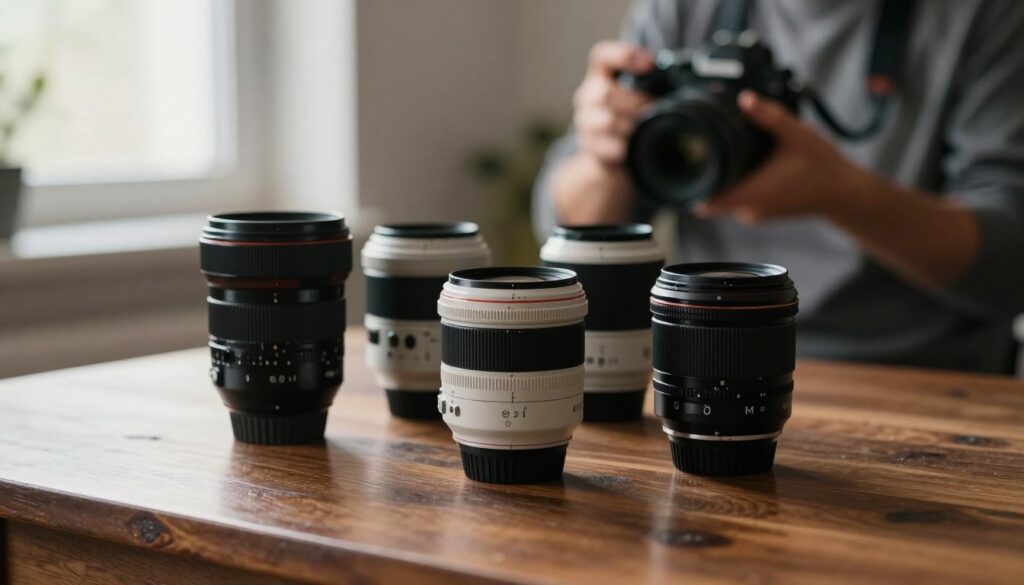
Developing Your Framing Skills
Start small: pick one focal length and commit to it for a stretch of frames. Jim Austin’s practice of 100 frames at 35mm helped him master composition in Atlantic City.
Practice routines I use:
- Shoot 100 frames at one focal length to learn how that lens renders a scene.
- Move deliberately until background elements align behind the subject.
- Keep one hand free while carrying a prime on the camera for balance and safety.
“Walk until the background elements align perfectly within your fixed lens view.”
Over time, this habit builds an intuitive sense for focal length and how the lens will capture a scene. It also teaches the best way to isolate a subject without a zoom lens.
| Technique | When to Use | Benefit |
|---|---|---|
| Commit to 100 frames | Learning a focal length | Faster framing instinct |
| Walk to reframe | Align background and subject | Cleaner composition |
| One-hand readiness | Street or travel shoots | Safety and stability |
Conclusion
Often the simplest change I make is a step forward; it redraws how a subject fits the frame.
As Ernst Haas said, “The best zoom lens is your legs.” That idea still guides me. Practicing zoom feet and even zooming feet shows a real difference in how a lens renders scene and background.
While a zoom has its place, using a prime lens forces me to engage more with light and focal length. I do not ask you to sell gear, but try a fixed length for a day and watch the effect on composition.
Master these moves and the camera will feel less like a tool and more like an extension of my vision. That small thing often makes the difference between good and great photos.
FAQ
What does “zooming with my feet” mean when I use a fixed lens?
I mean I move closer to or farther from the subject to change framing instead of changing focal length. With a prime lens, I control composition by adjusting my position, which keeps image quality high and helps me refine the scene and background relationships.
Why choose a prime lens over a zoom lens for this approach?
I prefer prime lenses because they often deliver sharper results, wider apertures, and simpler handling. They force me to think about composition and depth, which improves my creative decisions and makes the process more deliberate.
How does focal length affect the angle of view and the look of my subject?
Focal length controls the angle of view. Shorter focal lengths include more of the scene and emphasize depth, while longer ones compress perspective and isolate the subject. I use that knowledge to choose the best distance and position for the story I want to tell.
What’s the difference between recomposing and physically moving to frame a shot?
Recomposing means altering the camera angle or tilt while staying in roughly the same spot, which can change background elements or perspective slightly. Physically moving lets me change scale, perspective, and background relationships more dramatically. I move when I need precise control over these factors.
How can I develop better framing skills with a fixed lens?
I practice by limiting myself to one focal length and shooting different subjects every day. I focus on distance, height, and subtle shifts left or right. Reviewing images and noting how small changes affect composition speeds up my learning.
What practical techniques help me manage background and subject separation?
I use shallow depth of field, change my distance to the subject, and alter the angle of view to control background presence. Choosing a point of view that contrasts subject and background helps me create clear separation without relying on focal-length changes.
Can I achieve the same creative effects as zoom lenses using this method?
I can achieve many of the same effects, like subject isolation and perspective shifts, but I may need to move more or use different apertures. Some rapid focal adjustments that zoom lenses offer take more time when I rely on physical movement.
How do I handle time-sensitive situations when I can’t move freely?
I plan ahead by using positions that offer quick access to multiple framing options. I also preset focus points and practice rapid footwork so I can shift composition fast. In moments where movement is impossible, I rely on recomposing and aperture choices.
Will this technique affect my workflow in events or portrait sessions?
It will change how I work. I stay active and scout the area to identify backgrounds and distances. Clients often appreciate the focused attention to framing, and the final images usually feel more intentional and cohesive.
Which lenses and focal lengths are best to practice this skill?
I recommend starting with common primes like 35mm, 50mm, or 85mm on full-frame bodies, or their APS-C equivalents. These focal lengths give distinct perspectives and teach me how distance alters composition and subject rendering.
Noah Sterling is a prime lens photographer and visual storyteller dedicated to capturing sharp, intentional imagery through fixed focal lengths. He shares practical insights on composition, depth, and lens choice, helping photographers master simplicity and achieve powerful, professional results.